
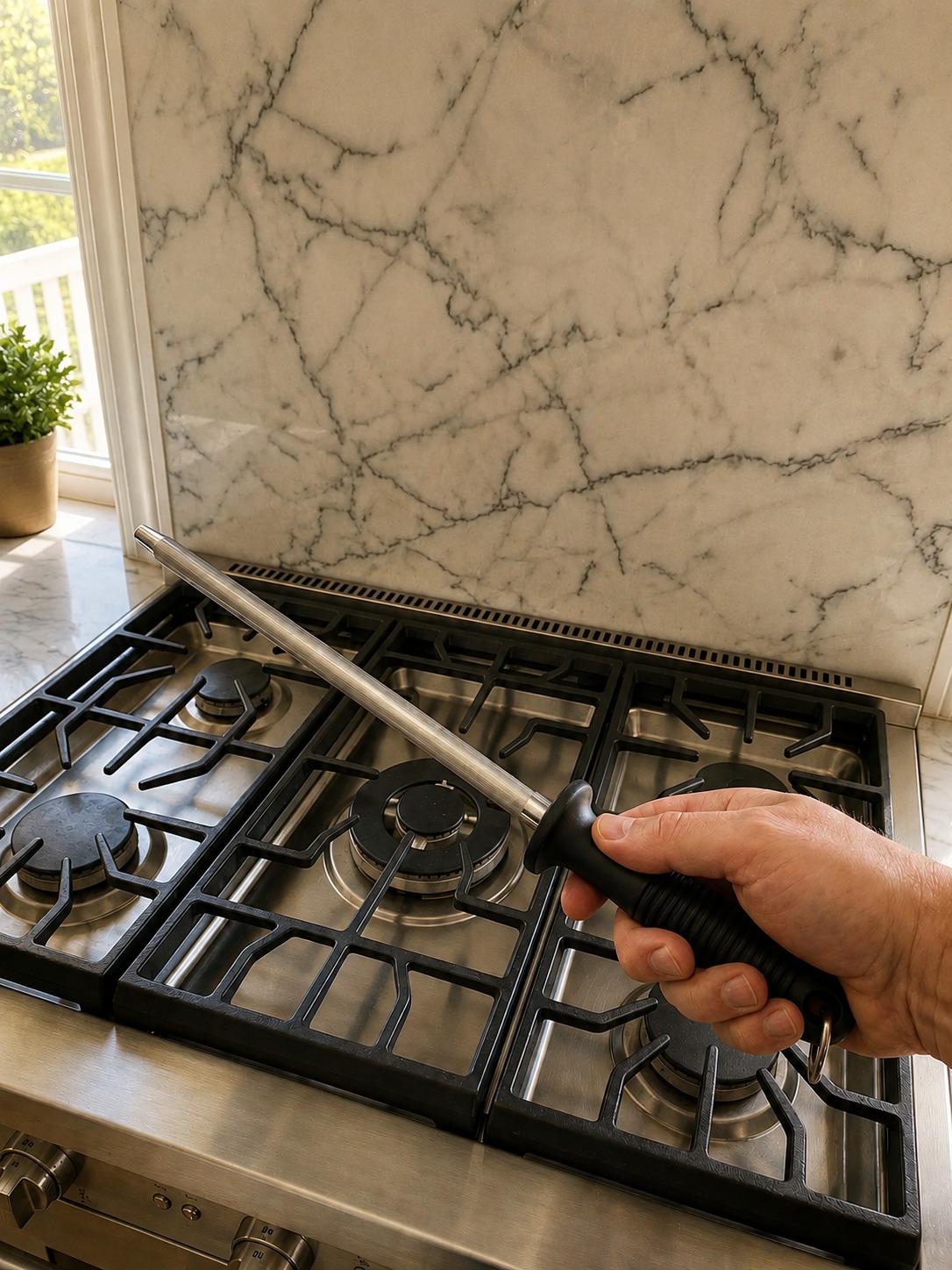
The Big Mix-Up: Why Honing and Sharpening Get Confused
Here’s the heart of the problem: we use the word sharp to describe how a knife feels. And honing often makes a knife feel sharper, even though it’s not technically sharpening it.
That’s where the wires get crossed.
So someone uses the rod, the knife cuts better, and naturally they think, “Well, I sharpened it.” Fair enough. From their point of view, something worked.
But what really happened is a little different.
What a Honing Rod Actually Does (Plain and Simple)
Inside every knife edge, there’s a very thin line of metal. Over time, that edge doesn’t just wear down. It also bends. Tiny amounts, but enough to matter.
Picture a row of grass after people have walked through it. The blades are still there, just leaning in different directions.
A honing rod:
Pushes that bent edge back into line
Straightens what’s already there
Makes the blade feel crisp again
It doesn’t grind away metal. It doesn’t rebuild the edge. It just tidies it up, so to speak.
That’s why chefs use honing rods so often. A few quick swipes during service keep knives behaving nicely between real sharpening sessions.
So yes, honing is helpful. Very helpful. It just isn’t the whole story.
What Sharpening Really Means (and Why It Feels Different)
Sharpening is where metal actually gets removed from the blade. Just a tiny bit, but enough to form a brand-new edge.
This happens when you use:
Sharpening stones
Pull-through sharpeners
Electric sharpeners
All of these have abrasive surfaces that reshape the blade. They take off dull metal and leave behind a fresh, clean edge that comes to a point again.
That’s why sharpening takes longer and feels more serious. Because it is.
And it’s also why you don’t need to do it every week. A good knife doesn’t need constant grinding. That would wear it down too fast.
Why Honing Alone Can’t Rescue a Truly Dull Knife
Here’s where family debates often get stuck.
If the edge is just bent, honing works wonders. But if the edge has actually worn away, there’s nothing left to straighten. You can swipe that rod all day and it won’t bring back what isn’t there anymore.
It’s like trying to comb hair that’s been cut too short. The comb isn’t the problem. There’s just nothing to fix.
That’s when sharpening becomes necessary. Not because someone did something wrong, but because the knife has simply reached that stage.
How Often Should You Hone vs Sharpen?
This part surprises people.
Honing?
You can do that often. Every few cooking sessions if you want. Some folks do it every time they cook.
Sharpening?
Much less often. For most home kitchens, every few months is plenty. Maybe more if you cook daily. Maybe less if the knives don’t get much action.
If your knife feels better after honing, great. Keep doing it. But when honing stops making a difference, that’s your sign it’s time for sharpening.
No drama required.
A Little Story (Because These Things Are Never Just About Knives)
I once watched a perfectly polite discussion turn into a full-blown standoff between two people who both cared very much about feeding the family well.
One insisted the rod was all anyone needed. The other kept saying, “No, it’s still dull.”
They were both right, in their own way.
One was talking about maintenance. The other was talking about repair.
Once that clicked, the whole mood changed. We sharpened the knife, had a laugh, and moved on to dessert.
Funny how fast things calm down when everyone feels heard.
How to Tell What Your Knife Actually Needs
You don’t need special tools for this. Just a little observation.
Try these:
Paper test: Can it slice cleanly through a sheet of paper?
Tomato test: Does it pierce the skin easily, or does it skid?
Honing test: Does the rod noticeably improve things?
If honing helps, great. If it doesn’t, sharpening is the next step.
No judgment attached. It’s just maintenance, like rotating tires.
Different Ways People Sharpen at Home
Now, sharpening can sound intimidating, but it doesn’t have to be.
Some options folks use:
Sharpening stones: Old-school, very effective, takes practice
Pull-through sharpeners: Simple, quick, good for busy kitchens
Electric sharpeners: Fast and consistent, though a bit aggressive on blades
Purists love stones. I admire them. Truly. But not everyone wants to stand at the counter learning angles after a long day. And that’s okay.
What matters more than the method is that sharpening actually happens at some point.
For Complete Cooking STEPS Please Head On Over To Next Page Or Open button (>) and don’t forget to SHARE with your Facebook friends
ADVERTISEMENT

