
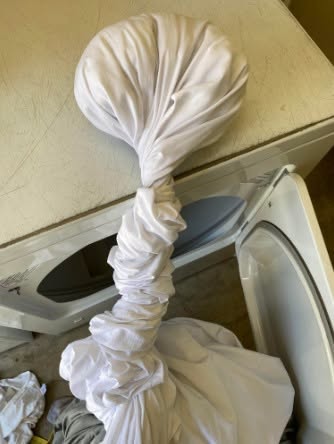
Once your sheets are separated and shaken out, you need to give the dryer some help. The tumbling action is what keeps fabrics from twisting, but heavy sheets can easily overpower the airflow.
Tools to Keep Sheets Moving:
Tool
How It Works
Why It’s Great
Wool Dryer Balls
These heavy, bouncy balls physically bounce between the layers of fabric, forcing them apart as the drum spins.
100% natural, reusable for thousands of loads, and they reduce drying time!
Clean Tennis Balls
If you don’t have wool balls, toss in 2 or 3 clean tennis balls. They do the exact same bouncing and separating job.
Cheap, easy to find, and highly effective at breaking up the “cotton meteor.”
A Dry, Clean Bath Towel
Adding a dry towel to a wet load of sheets helps absorb excess moisture and adds bulk to the tumbling action.
Helps the sheets dry faster and prevents them from clinging to each other.
🛑 Step 3: Don’t Overload the Drum
This is where many of us go wrong. We want to get all the laundry done in one go, so we stuff the dryer to the brim.
When a dryer is packed full, the sheets don’t have room to tumble. Instead of falling over each other, they just rub together in a tight circle, twisting into a massive knot.
The Golden Rule of Dryer Capacity:
✅ Leave room to breathe: Your dryer should only be about half to two-thirds full when drying large items like sheets.
✅ The Hand Test: If you can’t easily fit your hand and forearm into the dryer on top of the load, you’ve put too much in.
✅ Dry sheets alone: If possible, don’t mix heavy sheets with lightweight clothing. The heavy sheets will just drag the lighter items into the tangle.
🔄 Step 4: The Mid-Cycle Intervention
If you’ve done everything right but you’re drying a massive king-sized comforter set, the sheets might still try to team up against you.
The Fix: Set a timer for 20 or 30 minutes. When it goes off, pause the dryer, open the door, and give the load another quick shake. If you feel a knot forming, pull it apart manually, close the door, and let it finish. It takes ten seconds and saves you from having to re-wash or aggressively iron wrinkled linen later.
🧠 The Physics: Why Do Sheets Ball Up Anyway?
You mentioned you didn’t know the physics of why this happens. It actually comes down to a phenomenon laundry experts call the “Kangaroo Pouch Effect.”
When a fitted sheet or a duvet cover is tumbling in the dryer, the opening of the fabric acts like a pouch. As other lightweight items (like pillowcases or the flat sheet) float through the air inside the drum, they get caught inside the opening of the fitted sheet.
Once the other items are inside, the centrifugal force of the spinning drum causes the fabric to twist tightly around them, trapping everything inside. By shaking them out before they go in, and using dryer balls to keep the “pouch” open, you disrupt this physics loop!
❓ Frequently Asked Questions
Q: Will using dryer balls damage my sheets?
A: No! High-quality wool dryer balls are completely safe for all fabrics, including delicate linens. They are soft enough not to cause pilling or tearing, but firm enough to separate the layers.
Q: Can I use the “Air Fluff” or “No Heat” setting to untangle them?
A: Yes! If you pull out a giant ball of sheets, you can toss them back into the dryer on the “Air Fluff” (no heat) setting for 10 minutes with a couple of dryer balls. The tumbling action without the heat will often shake the knot loose.
Q: Why do my sheets come out so wrinkled even if they didn’t ball up?
A: Wrinkles set when hot fabric sits in a pile as it cools. The moment the dryer stops, take the sheets out immediately. If you can’t fold them right away, lay them flat on the bed or drape them over a clean chair so they can cool down evenly.
Q: Does using too much fabric softener make the tangling worse?
A: It can! Fabric softeners coat the fibers in a waxy residue, which can actually make fabrics more prone to clinging to one another and reducing the dryer’s airflow. Try using wool dryer balls instead—they naturally soften fabrics by tumbling against them without the chemical coating.
Q: Is it better to dry sheets on high or low heat?
A: Low or medium heat is always better for your sheets. High heat breaks down the cotton fibers over time, causing them to weaken and pill. Plus, lower heat reduces the static cling that makes sheets stick together in the first place!
For Complete Cooking STEPS Please Head On Over To Next Page Or Open button (>) and don’t forget to SHARE with your Facebook friends
ADVERTISEMENT

