
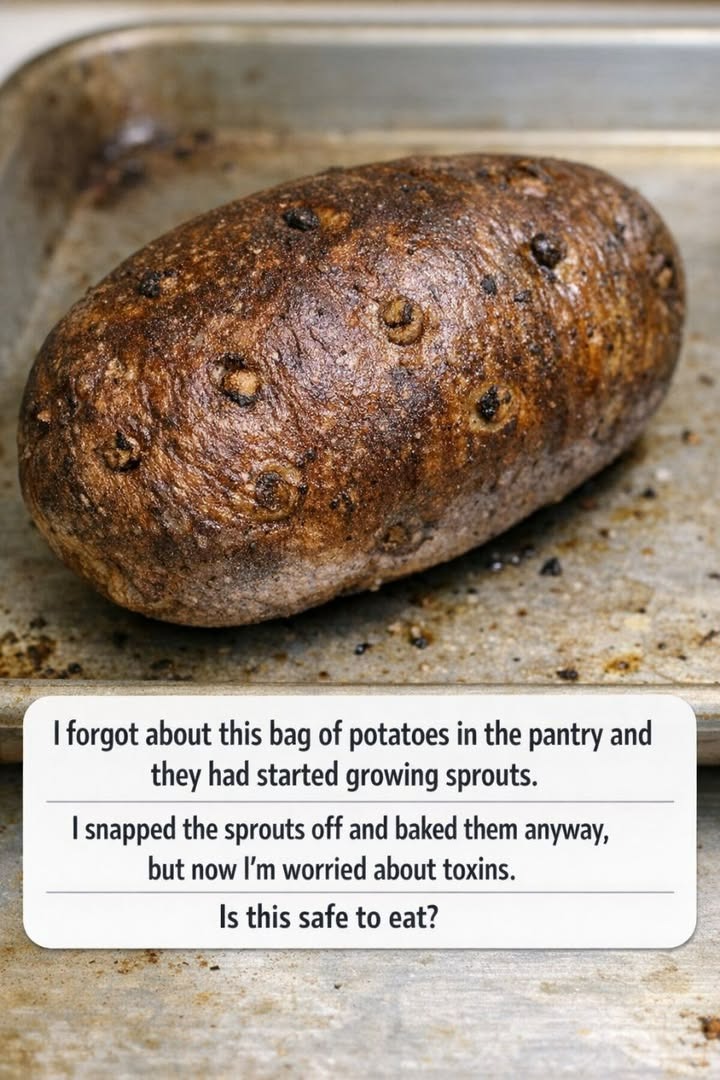
Let me explain what’s happening inside that forgotten bag.
Potatoes are living tubers—they’re still alive when you buy them. They contain dormant “eyes” (buds) that are waiting for the right conditions to grow. When they’re exposed to warmth, light, and moisture, those buds wake up and start growing into sprouts.
What’s happening chemically: As the potato sprouts, it produces a natural toxin called solanine. This is the potato’s defense mechanism—it makes the potato taste bitter and unpleasant to animals (and humans) who might try to eat it.
Where solanine concentrates: In the sprouts themselves, in the “eyes” (where the sprouts grow from), and in any green patches on the skin (green indicates chlorophyll production, which often accompanies solanine).
The good news: The solanine concentration in the potato flesh itself is usually low. If you remove the sprouts and any green spots, the remaining potato is generally safe to eat.
Is Sprouted Potato Poisoning Real? (The Risks)
Yes, solanine poisoning is real—but it’s rare and usually mild.
Symptoms of solanine poisoning:
Nausea, vomiting, diarrhea
Stomach cramps
Headache
In severe cases: confusion, fever, hallucinations (extremely rare)
Who is most at risk: Children, elderly, and people with compromised immune systems may be more sensitive.
How much is dangerous? Solanine poisoning typically requires eating a large quantity of badly sprouted or green potatoes. A few small sprouts removed from an otherwise firm potato is not a concern.
The bottom line: Your body is good at detecting solanine. If a potato tastes bitter or causes a burning sensation in your mouth, stop eating it.
How to Safely Prepare Sprouted Potatoes (Step-by-Step)
Let me give you a clear, actionable guide.
Step 1: Inspect the Potato
Firm and solid? Good. Proceed.
Wrinkled, shriveled, or soft? Toss it. The potato has lost too much moisture and may have higher solanine levels.
Step 2: Remove the Sprouts
Use your fingers or a small knife to snap or cut off all sprouts. Dig out the “eyes” (the spots where the sprouts grew) as well—that’s where solanine is concentrated.
Step 3: Cut Away Green Spots
Any green patches on the skin or flesh should be cut off completely. The green color is chlorophyll, which indicates solanine is present.
Pro tip: If the potato is mostly green (large patches), toss the whole potato.
Step 4: Peel the Potato (Optional but Recommended)
Peeling removes the skin, where solanine is most concentrated. For sprouted potatoes, peeling is a good safety measure.
Step 5: Cook Thoroughly
Cooking does not destroy solanine. However, it does make the potato tastier and easier to digest. Boiling, baking, roasting, or frying are all fine.
Step 6: Taste Test
Take a small bite before eating a large portion. If the potato tastes bitter or causes a burning sensation on your tongue, stop eating and toss the batch.
When to Toss the Whole Potato (Don’t Risk It)
Let me give you clear red flags.
Toss the potato if:
It’s soft, mushy, or wrinkled (signs of decay).
It has large green patches (more than 10-15% of the surface).
It smells bad (rotten, musty, or fermenting).
It has black spots or oozing liquid (signs of bacterial rot).
It’s been stored for months and is clearly past its prime.
When in doubt, throw it out. A potato costs pennies. Food poisoning costs much more.
How to Prevent Potatoes from Sprouting (Storage Tips)
Let me help you avoid this problem in the future.
Store in a cool, dark place. Ideal temperature is 45-50°F (7-10°C). A basement, cellar, or cool pantry is perfect. Do not store under the sink (too warm and humid).
Keep away from onions. Onions release ethylene gas, which causes potatoes to sprout faster. Store them separately.
Don’t refrigerate raw potatoes. The cold converts starches to sugars, affecting flavor and texture. It can also cause them to darken when cooked.
Use paper bags. Plastic bags trap moisture and promote sprouting and rot. Paper bags allow airflow.
Store in single layers. Don’t pile potatoes on top of each other. Spread them out so air circulates.
Check regularly. Once a week, check your potato stash. Remove any that are sprouting or soft before they affect the others.
For Complete Cooking STEPS Please Head On Over To Next Page Or Open button (>) and don’t forget to SHARE with your Facebook friends
ADVERTISEMENT

