
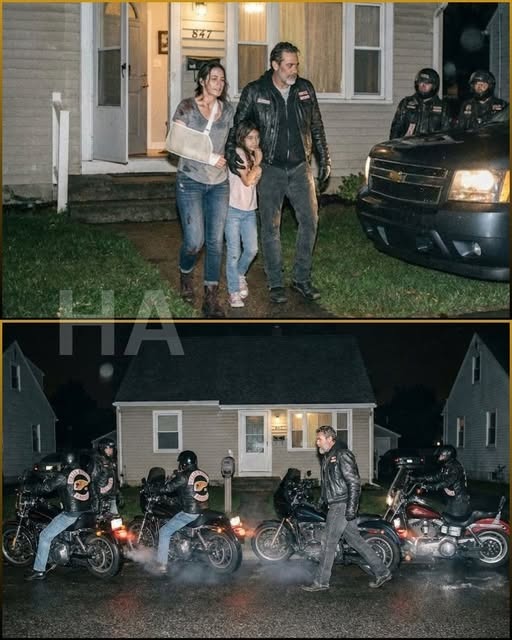
I closed my eyes for half a second. “Okay. That’s good. Stay on the phone with me. We’re coming right now.”
Outside, four Harleys sat in the lot like crouched animals.
We fired them up.
The engines roared into the night, and for the first time in a long time, that sound didn’t feel like a threat. It felt like a promise.
“Do you hear that?” I asked her, wind already snapping my words.
“Yes,” she whispered, awe threaded through fear.
“That’s me and my brothers,” I told her. “We’re on our way.”
And we were.
Chapter 2: The Kitchen Floor and the Quiet Monster
Maple Creek Lane didn’t look like a place that expected rescue. It looked like a place that had learned to survive without it.
We cut our engines at the curb. The sudden silence after the roar felt like falling into deep water.
I kept the phone against my helmet. “Meera, I’m outside. Front door.”
“I… I locked it,” she said, voice wobbling.
“Good. You did the right thing. Can you unlock it for me? Just the deadbolt. Then step back.”
I heard the scrape of metal. The cautious click.
When the door opened a crack, she was there.
Nine years old. Pajamas. Hair tangled into a frightened halo. Her face streaked with tears. Her hands… her hands were smeared with blood like she’d tried to wipe a nightmare off her skin and it wouldn’t come off.
Her eyes landed on me and my cut, and for a split second I saw her flinch like she expected another kind of danger.
I dropped to one knee immediately. Took the height out of the moment.
“Hey,” I said softly. “You’re Meera.”
She nodded, lips trembling.
“You did something really brave,” I told her. “You reached out. You didn’t freeze. You saved your mom.”
Her eyes flicked behind me, toward my brothers. Four big men in leather in her doorway. A child’s brain trying to decide if the cure looks too much like the disease.
I held out my hands, palms open. “Can I come in?”
She hesitated. Then, with the simple logic of terror, she stepped back and let us pass.
The smell hit first. Not gore. Not movie horror. Something worse in its ordinariness: spilled soda, old grease, and blood. Blood has a copper smell that doesn’t ask your permission to remember it.
Sarah Lane lay on the kitchen floor. Her arm was bent wrong. The wrongness wasn’t dramatic, it was factual, like math. A broken body doesn’t always look like chaos. Sometimes it looks like a person who just… stopped.
Reaper was on her instantly, kneeling beside her with a gentleness that would surprise anyone who’d ever seen him throw a punch.
“Breathing,” he muttered. “Pulse weak but there.”
Chains stripped off his flannel and folded it into a compress with hands that usually handled wrenches and throttle grips.
“Gunner,” I said. “Call 911. Now.”
Gunner did, voice calm, giving details like a man who had learned that panic wastes seconds.
Meera stood in the doorway, frozen, watching her mother as if staring hard enough could wake her.
I moved toward her. Slowly. Like you approach an animal caught in a trap.
“Meera,” I said, “I need you to come with me for a second.”
“I can’t leave her,” she whispered.
“You won’t,” I promised. “But I’m going to take you to the living room, okay? So you don’t have to see… all of this.”
She didn’t move.
So I made a choice that felt strange in my hands.
I took off my cut.
My vest with the patches. The thing that tells the world don’t test this man. I folded it and wrapped it gently around her shoulders like a blanket.
Her eyes widened.
“It’s heavy,” she murmured, surprised.
“Yeah,” I said. “It’s got a lot of history in it.”
She clutched it like armor.
And then, like a dam deciding it couldn’t hold anymore, she stepped into my chest and broke.
She sobbed so hard her whole body shook. A child’s grief is pure physics. It doesn’t perform. It just happens.
I held her carefully, like you hold something fragile you didn’t know you needed to protect.
Behind me, Reaper’s voice was steady. “We need to keep her awake. Sarah? Hey. Stay with me.”
Sarah groaned. Barely.
Meera heard it. Her head snapped up. “Mama?”
“Ambulance is five minutes out,” Gunner said.
Five minutes is a long time when you’re nine and the floor feels like it’s swallowing your mother.
So I kept Meera talking.
“Tell me about your mom,” I said quietly. “What does she like?”
Meera wiped her nose on my vest without thinking. “Pancakes,” she whispered. “On Sundays. She burns the first one on purpose.”
“On purpose?” I asked, even though I knew what she meant.
Meera nodded, a tiny smile flickering like a match in rain. “She says the first pancake is for the bad luck. Then the rest are good.”
I swallowed hard.
Because the first pancake had already burned tonight.
Chapter 3: Sirens, Fluorescent Lights, and the Look People Give Us
When the paramedics arrived, the house filled with brisk voices and medical terms. Sarah was stabilized, loaded onto a stretcher, and moved out into the night under flashing lights.
Meera tried to follow, frantic.
I scooped her up before she could run into the path of the stretcher. She weighed almost nothing. That’s what kills you about kids: how little they are, how huge their fear feels.
“You’re coming,” I told her. “You’re not getting left behind.”
“But the ambulance…” she stammered.
“We’ll follow,” I said. “Right behind.”
SEE NEXT PAGE
ADVERTISEMENT

