
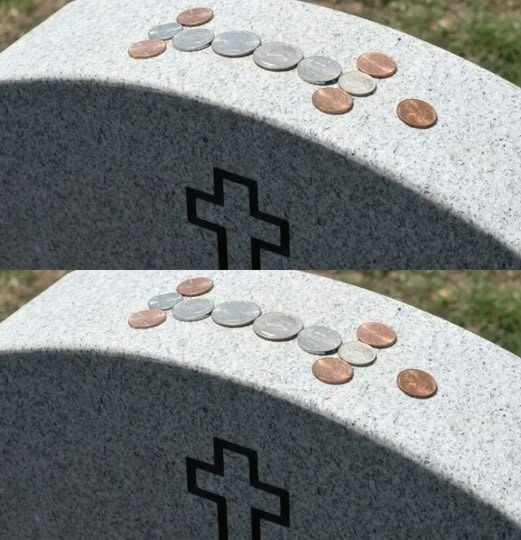
As you walk through a quiet cemetery, sunlight filtering through trees, you might notice something small but striking:
👉 A penny, nickel, dime, or quarter resting on a tombstone.
At first glance, it seems like litter.
But it’s not.
It’s a message.
A tribute.
A silent conversation between the living and the dead.
Leaving coins on graves is an ancient custom with roots stretching back to antiquity — one that evolved into a powerful modern tradition, especially among veterans, families, and friends honoring those who served.
Let’s explore what these small tokens really mean — so the next time you see a coin glistening on stone, you’ll understand the story behind it.
Because real remembrance isn’t loud.
It’s quiet.
And sometimes,
it fits right in the palm of your hand.
🏛️ Ancient Origins: A Coin for the Ferryman
The practice dates back over 2,000 years to ancient Greece and Rome.
Families placed a coin (often an obol) in or on the mouth of the deceased before burial.
Why?
According to mythology, the soul had to cross the River Styx to reach the afterlife — guided by Charon, the ferryman.
The coin was payment for passage.
Without it, the soul would be left to wander the shores for eternity.
While this belief has faded, the symbolic act of leaving a coin endured — transformed by time and culture into a gesture of love, respect, and connection.
🇺🇸 Modern Military Tradition: What Each Coin Means
In the U.S., placing coins on military headstones became common during the Vietnam War era — as a way for fellow service members to silently say:
“I was here. I remember. You’re not forgotten.”
Each denomination carries a specific meaning:
Coin
Meaning
✅ Penny (1¢)
A visitor paid their respects
“I stopped by to honor you.”
✅ Nickel (5¢)
Left by someone who trained with the deceased at boot camp
“We went through basic together.”
✅ Dime (10¢)
Placed by someone who served alongside them in combat or unit
“We were in the same unit. I knew you.”
✅ Quarter (25¢)
Left by someone who was present when the service member died
“I was there. I will never forget.”
🪖 These gestures are deeply personal — often made by comrades who may struggle to speak about loss.
🤝 Beyond the Military: Personal Tributes
While most visible at veterans’ graves, people also leave coins on civilian headstones — though meanings vary:
Reason
Explanation
ADVERTISEMENT

