
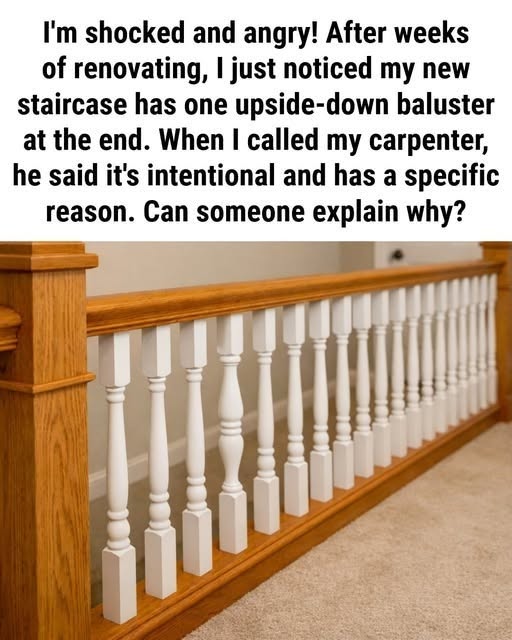
🛠️ Why Balusters Actually Get Installed “Upside-Down”
Cause
Explanation
Symmetry illusion
Turned balusters often have identical top/bottom profiles—orientation is arbitrary
Production efficiency
Carpenters install spindles quickly; flipping one saves seconds during assembly
Replacement error
A damaged baluster replaced by a homeowner who didn’t notice the original orientation
Design choice
Some styles (like barley-twist) intentionally alternate directions for visual rhythm
📏 Architectural note: In true historic craftsmanship (1700s–1800s), balusters were custom-turned to fit specific stair angles—making random inversion unlikely. Mass-produced balusters (post-1900) lack this precision.
✅ When It Might Be Intentional (Rare Exceptions)
While not tied to “humility” traditions, these scenarios exist:
Artisan signature: A modern woodworker might invert one spindle as a hidden “signature”
Restoration quirk: A preservationist replicating an existing “mistake” for historical accuracy
Deliberate design: Contemporary architects using inversion for visual disruption
But these are conscious artistic choices—not ancient spiritual practices.
🌍 Real “Intentional Imperfections” That Are Documented
If you love this philosophy, focus on traditions with verified roots:
Tradition
Purpose
Cultural Origin
Navajo “spirit line”
Allows weaver’s spirit to exit the rug
Diné (Navajo) Nation
Islamic geometric “flaws”
Acknowledges Allah’s perfection
Islamic architecture (8th c.+)
Persian carpet “kheshti”
Avoids pride in human creation
Persian weaving
Amish “humility blocks”
Rejects vanity in quilting
Amish communities (1800s+)
❤️ Respectful note: These practices are sacred cultural expressions—not decorative tricks. Appreciate them in context.
For Complete Cooking STEPS Please Head On Over To Next Page Or Open button (>) and don’t forget to SHARE with your Facebook friends
ADVERTISEMENT

