
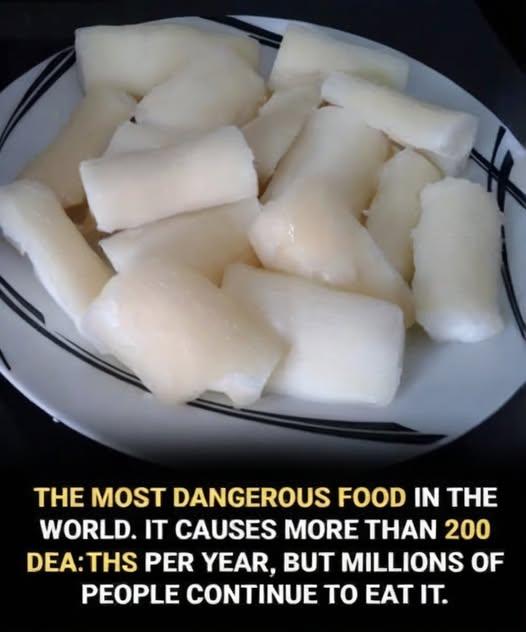
Over 200 People Die Each Year from the “World’s Deadliest Food” — Yet Nearly 500 Million Still Eat It
It feeds entire nations. It anchors economies. It appears on dinner tables across Africa, South America, and the Caribbean.
And yet, when prepared incorrectly, this everyday food can be fatal.
Cassava—a humble root vegetable also known as yuca—sustains nearly 500 million people worldwide, but is also responsible for hundreds of deaths and thousands of cases of neurological damage every year. This striking contradiction has earned it a chilling nickname: the world’s deadliest food.
How can a single crop be both a lifeline and a lethal risk?
What Is Cassava?
Cassava is a starchy root native to South America and now widely cultivated in tropical regions around the world. It thrives where many other crops fail—tolerating drought, poor soil, and extreme heat—which makes it indispensable in areas facing food insecurity.
There are two primary varieties:
- Sweet cassava – Contains lower toxin levels and can be made safe with basic cooking
- Bitter cassava – Contains much higher levels of natural toxins and requires careful processing
Despite its risks, cassava is incredibly versatile. It’s the foundation of foods such as tapioca, garri, fufu, cassava flour, and countless traditional dishes.
Why Cassava Can Be Dangerous
The danger comes from cyanogenic glycosides, naturally occurring compounds found in cassava—especially bitter varieties.
When cassava is peeled, grated, or chewed, these compounds can convert into hydrogen cyanide, a potent poison.
If cassava is eaten without proper detoxification, it can cause:
- Acute cyanide poisoning – nausea, vomiting, rapid breathing, seizures, and death within hours
- Konzo – an irreversible paralysis affecting the legs, most often seen in malnourished communities
- Tropical ataxic neuropathy – a chronic condition causing vision loss, hearing impairment, and coordination problems
According to global health data, cassava causes more food-related cyanide poisoning than any other crop in the world.
How Cassava Poisoning Happens
Cassava poisoning is rarely accidental—it’s usually the result of extreme hardship.
Common risk factors include:
- Drought and famine, forcing early harvesting when toxin levels are highest
- Lack of clean water, making soaking and washing impossible
- Poverty and limited food access, leaving cassava as the only available staple
- Time pressure or lack of knowledge, leading families to skip traditional preparation methods
In these conditions, cassava is consumed before toxins have been fully removed.
How Cassava Is Made Safe
LOOK NEXT
ADVERTISEMENT

