
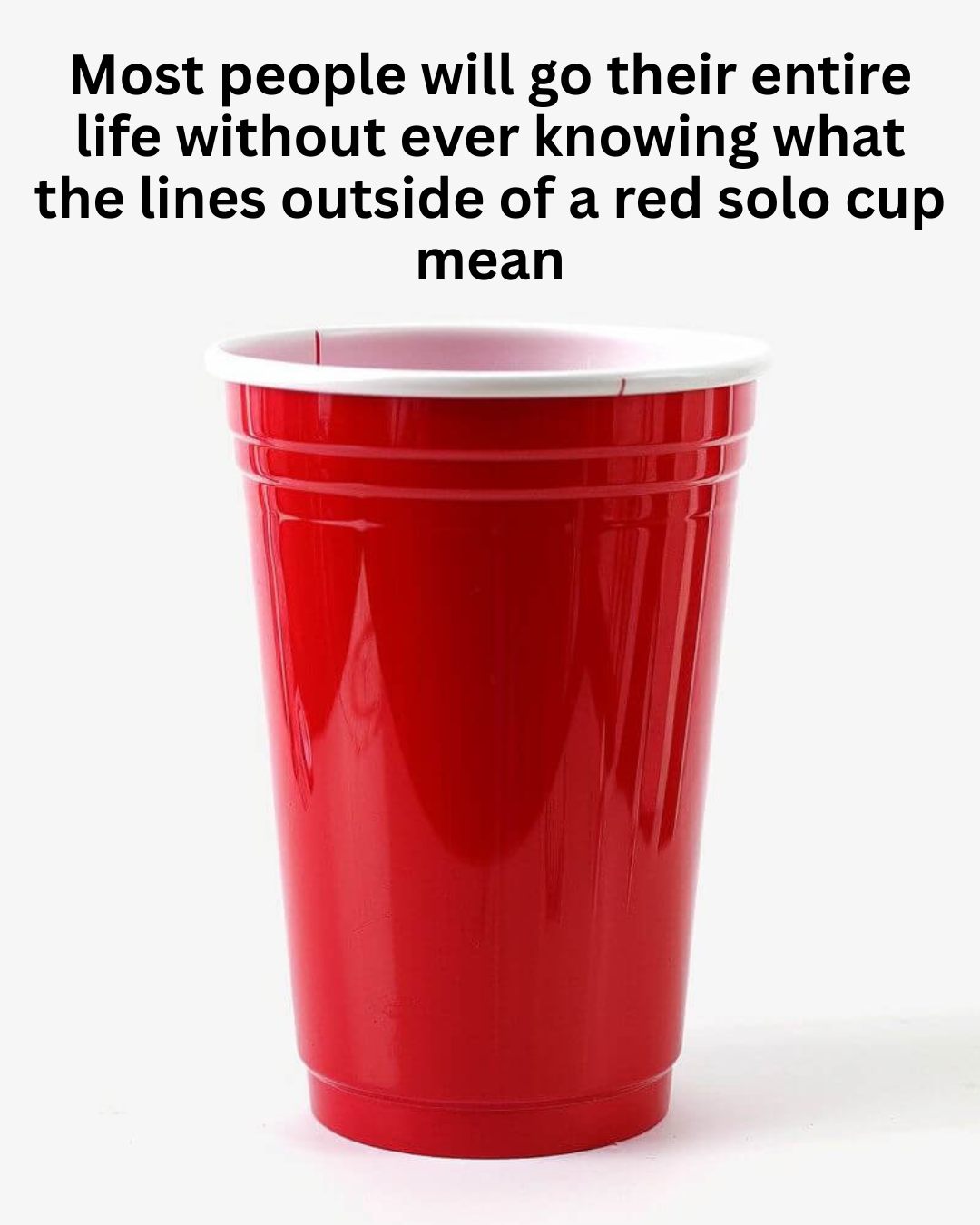
There’s a long-running belief—part practical joke, part useful party wisdom—that the ridges on a standard red Solo cup correspond loosely to drink portions:
Bottom line: roughly 1 ounce (a pour of spirits)
Middle line: around 5 ounces (a wine serving)
Upper line: about 12 ounces (beer or soda)
Convenient, right?
Almost suspiciously convenient.
Now, to be fair, these markings weren’t officially engineered as precise bartending measurements across all cup versions. Different cup models vary, and even Dart Container has indicated the ridges weren’t designed as certified measuring marks.
Still… people use them that way. And they work well enough that the myth stuck.
And honestly? Sometimes folklore hangs around because there’s truth hiding in it.
A Party Hack Hiding in Plain Sight
Think about a crowded party.
Nobody’s pulling out a measuring jigger.
Nobody’s saying, “Excuse me while I precisely portion this merlot.”
You eyeball it.
And these lines make eyeballing easier.
That’s clever design—even if partly accidental.
It reminds me of the little indent on a wine bottle punt. People argue about what it’s for all the time. Stability? Sediment? Fancy tradition? Sometimes a design feature does more than one thing.
Same idea here.
The cup quietly helps.
No fuss.
No instruction manual.
Just a little plastic nudge.
Honestly, It Can Help With Responsible Drinking
And this part matters more than people realize.
Knowing what roughly counts as a serving can help people keep track.
Not in a preachy way.
Just practically.
If the lower ridge gives you something close to a shot pour, and the middle helps with wine, that makes moderation easier without turning a casual gathering into chemistry class.
That’s useful.
Especially because party culture and overpouring often go hand in hand.
You know what? Sometimes the simplest tools are the ones people actually use.
And a cup you already have in your hand qualifies.
But Those Lines Do More Than Measure
Here’s where it gets even more interesting.
The ridges also strengthen the cup.
Take a plain thin plastic cup with smooth sides—it flexes more.
Add rings and grooves?
You increase structural rigidity.
That means:
Better grip
Less collapse when squeezed
Easier stacking
More stability on tables (well… relatively speaking)
It’s a little bit engineering, a little bit manufacturing efficiency.
Kind of wild for something usually sitting next to a bowl of chips.
And yet there it is.
Why Almost Nobody Notices
Because familiarity blinds us.
Seriously.
Psychologists talk about this all the time—we stop seeing details in things we encounter constantly.
Door handles.
Coffee lids.
Paper clips.
Solo cups.
We register function and move on.
Plus, nobody markets the cup by saying:
“Now featuring hidden beverage calibration ridges!”
That would be… a strange ad.
So the detail stays hidden in plain sight.
Which almost makes it more fun.
And Then There’s the Cultural Mythology
The red Solo Cup is bigger than plastic.
It became shorthand for a whole mood.
Casual fun.
Summer nights.
Backyard lights strung over a patio.
Country songs blaring.
There’s even Red Solo Cup, which basically turned a disposable cup into a pop-culture character.
That doesn’t happen by accident.
Objects become symbols when people attach memories to them.
And the cup has decades of memories soaked into it.
Messy ones.
Funny ones.
Some maybe best left untold.
That matters.
Design and culture tend to feed each other.
The object works well, so people use it.
People use it, so it becomes symbolic.
Then its smallest details start carrying stories too.
Even the little ridges.
The Funny Thing? It May Be Part Myth… and Still Useful
Here’s a mild contradiction—and it’s worth saying out loud.
Are those lines officially standardized measuring marks?
Not exactly.
For Complete Cooking STEPS Please Head On Over To Next Page Or Open button (>) and don’t forget to SHARE with your Facebook friends
ADVERTISEMENT

