
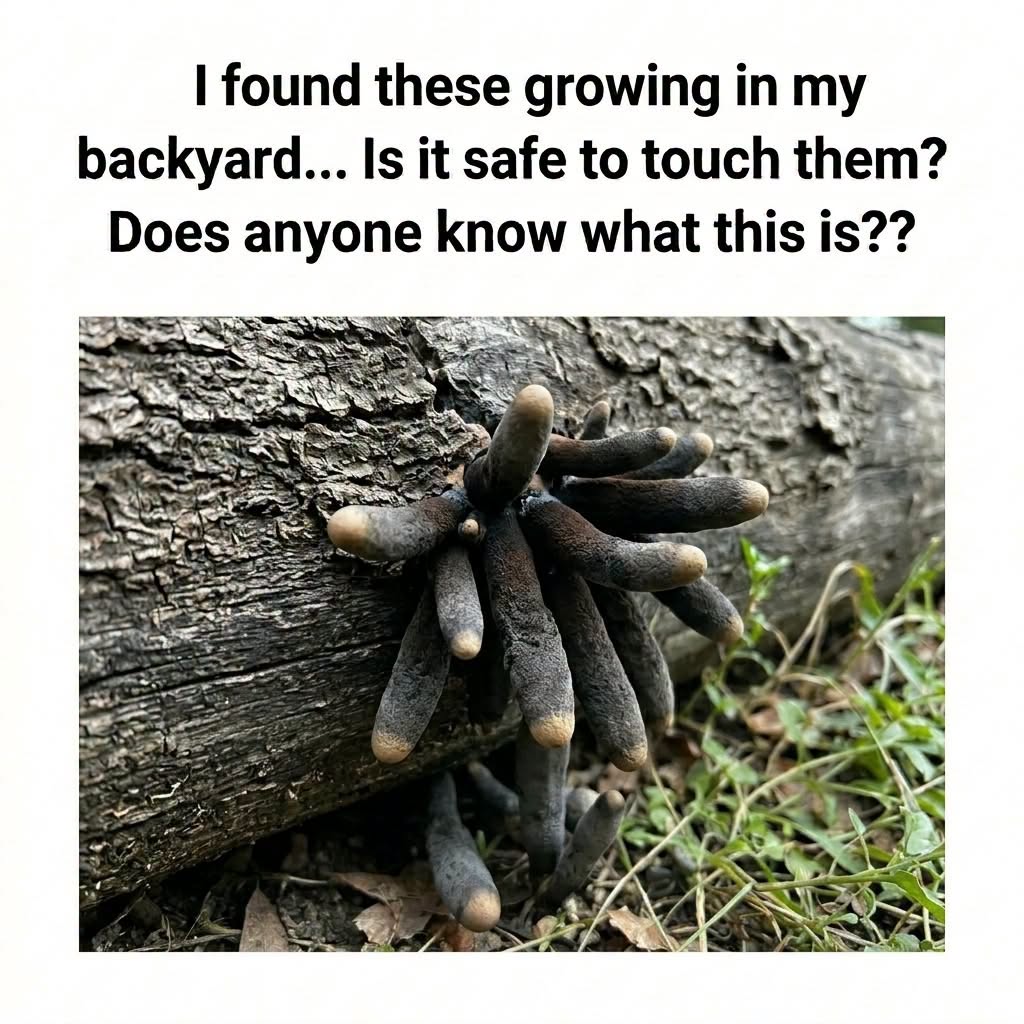
Understanding how Dead Man’s Fingers grow makes them slightly less terrifying and much more fascinating.
Stage 1: The Invisible Network
Before you ever see a “finger,” there is an extensive network of mycelium (fungal threads) growing inside the dead wood. This network can live for years, quietly digesting the cellulose and lignin.
Stage 2: The Fruiting Body Emerges
When conditions are right (usually in late summer or autumn), the fungus sends up its reproductive structures—the “fingers” you see. These are technically called stromata.
Stage 3: Spore Release
The surface of the mature black fingers is covered in tiny pores. Inside these pores, the fungus produces spores. When the wind blows or rain hits, these spores are released to find new dead wood to colonize.
Stage 4: The Cycle Continues
After releasing spores, the fingers eventually decay, and the mycelium inside the wood continues its slow work until the log is completely broken down.
🍄 Edible? Absolutely Not.
This is a question that comes up often, and the answer is very clear: Oh heck no.
While Xylaria polymorpha is technically not poisonous in the sense that it contains deadly toxins, it is super woody and inedible. Chewing on one would be the same as gnawing on a stick or a piece of charcoal.
Why You Should Never Eat It:
❌ Texture: It is rock-hard and fibrous. You could chip a tooth.
❌ Taste: Even if you dried and ground it, it would be bitter, unpleasant, and a waste of time.
❌ Nutritional Value: It offers none.
❌ Digestibility: Your body cannot break down the tough, woody fibers.
This is a good reminder that “not toxic” doesn’t mean “good to eat.” There are many things in nature that won’t kill you but will definitely make you miserable.
💡 Pro Tip: Look at them, take a creepy picture for your friends, but don’t consider putting one in your dinner. Stick to the delicious, edible mushrooms like morels, chanterelles, and chicken of the woods!
🌲 Where to Find Dead Man’s Fingers
If you want to spot these eerie fungi, you need to know where to look. They are quite common in many parts of North America, Europe, and Asia.
Ideal Habitats:
✅ Deciduous Forests: Look in woods with beech, ash, maple, or sycamore trees.
✅ Rotting Stumps: Check old, decaying stumps, especially those that have been dead for a few years.
✅ Buried Roots: Sometimes they grow from roots that are underground, making it look like they are sprouting directly from the soil.
✅ Fall and Winter: They are most visible in late autumn and can persist through the winter, often looking even more skeletal when covered in frost or snow.
🧪 The Ecological Importance: Why We Need Them
As creepy as they look, Dead Man’s Fingers are actually heroes of the forest ecosystem. Without saprophytic fungi like Xylaria, the forest floor would be buried under meters of dead wood.
Their Vital Roles:
Role
Benefit to the Forest
Decomposers
They break down tough lignin and cellulose, turning dead wood into rich, fertile soil.
Nutrient Cyclers
They release nitrogen, phosphorus, and other minerals back into the earth for living plants to use.
Habitat Creators
As they hollow out logs, they create homes for insects, small mammals, and other fungi.
Carbon Storage
By slowing the decay process, they help regulate how quickly carbon is released back into the atmosphere.
For Complete Cooking STEPS Please Head On Over To Next Page Or Open button (>) and don’t forget to SHARE with your Facebook friends
ADVERTISEMENT

